Scientists from the UK Centre for Ecology & Hydrology (UKCEH) are among the contributors to a major international study showing how climate change is reshaping plant communities across Europe. This is the most comprehensive analysis to date for Europe that directly compares responses across different ecosystems.
The study, published in Nature, was led by researchers from the Forest & Nature Lab (ForNaLab, Faculty of Bioscience Engineering, Ghent University), with strong involvement from the Research Institute for Nature and Forest (INBO, Belgium).
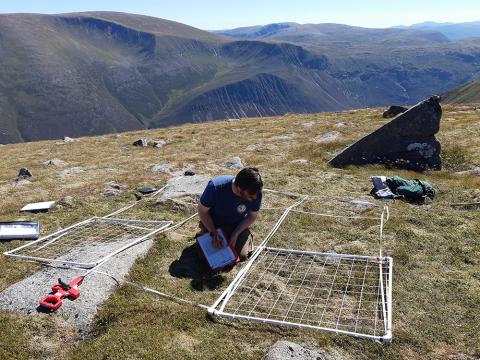
It analysed a unique database of more than 6,000 vegetation plots across forests, grasslands, and mountain summits, with observations spanning 12 to 78 years. This included mountain vegetation data from the NC-UK funded Environmental Change Network long-term monitoring site in the Cairngorms along with grassland data collected from the resurvey of 88 sites in Dorset, first surveyed in the 1930s.
Christopher Andrews and Jan Dick, who lead the monitoring and research activities at ECN Cairngorms, along with Professor James Bullock (all from UKCEH) were among the co-authors on the study. It reveals that European plants are responding unevenly to climate warming: mountain regions are rapidly losing cold-adapted species, while forests and grasslands are becoming increasingly dominated by warm-adapted species.
Key findings
- Thermophilisation visible everywhere: Plant species that prefer warmer conditions are increasing relative to cold-adapted species.
- Mountains hardest hit: In the Alps and other mountain regions, cold-adapted species are disappearing at a strikingly rapid pace.
- Forests and grasslands: These ecosystems show a strong relative increase in warm-adapted species, mainly due to colonisation by new species, but they are also losing some cold-adapted species.
- ‘Climatic debt’: Across all ecosystems, plant communities are responding more slowly than climate change itself, leading to an accumulation of 'climatic debt' that poses risks to biodiversity and ecosystem stability. Plants are no longer in equilibrium with the local climate.
Why is this important?
The results clearly show that climate warming does not have the same effects everywhere. Ecosystems respond differently depending on their structure and composition. This means that climate adaptation strategies must be tailored specifically to each ecosystem.
“Our study shows that we cannot write a single, uniform story about the impacts of climate warming. While mountain regions are losing species that cannot survive anywhere else, forests and grasslands are mainly shifting towards warm-adapted species. This has profound consequences for biodiversity conservation in Europe,” says Professor Pieter De Frenne (Ghent University).
Dr Jan Dick, leads UKCEH’s transdisciplinary research focused on coupled human-nature systems at long-term monitoring sites, including the mountain field site in the Cairngorms, which contributed data to this study. She comments:
“This global study shines a spotlight on the future of mountain vegetation so cherished by the UK public. Although many people who regularly walk in Scotland’s mountains have noticed changes firsthand, it takes long-term, standardised scientific monitoring to generate the robust evidence needed to inform policy and drive meaningful action.”
UKCEH ecologist Professor James Bullock, who contributed grassland data to the study, adds, “This type of global analysis is only possible through collaboration and long-term funding to support vegetation data gathering. The findings will help shape targeted management strategies, such as adaptive grazing practices in grasslands, to enhance ecosystem resilience and mitigate biodiversity loss under ongoing climate change.”
About the study
The research is a collaboration among dozens of scientists from across Europe, North America, and Asia. The unique dataset combines long-term surveys of plant communities from forests, grasslands, and mountain summits.
Further information
- Reference: Yue et al. 2026. “Contrasting thermophilization among European forests, grasslands and alpine summits”. Nature. DOI: 10.1038/s41586-025-09622-7
- ECN Cairngorms
- Monitoring of the Cairngorms Environmental Change Network site is supported by the Natural Environment Research Council award number NE /Y006208/1 as part of the NC-UK programme delivering National Capability.
(Article adapted from a news item first published on the UKCEH website)