The wildfires in the Cairngorms seen this summer are a reminder of how vulnerable mountain ecosystems are becoming to a changing climate. Wildfires are dramatic events that capture attention, but many changes occurring in high mountain landscapes are much less visible. They take place gradually over decades and are only detected through sustained, long-term monitoring.
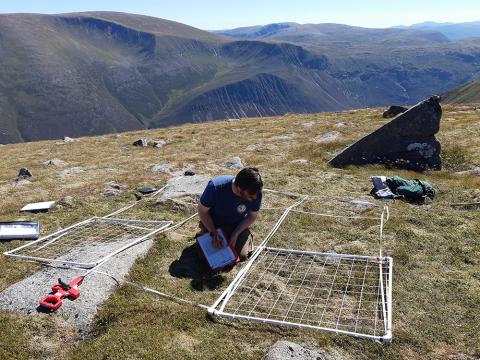
In a new blog post, Jan Dick of the UK Centre for Ecology & Hydrology, explains the importance of the Global Observation Research Initiative in Alpine Environments (GLORIA). Data from repeat surveys is collected from mountain tops across Europe using a standardised monitoring protocol, building one of the world's most comprehensive records of climate-driven ecological change. Jan, together with fellow ECN Site Manager, Chris Andrews (pictured above), have contributed to this European study for the past 20 years, collecting detailed vegetation survey data from four summits in the Cairngorms.
As Jan explains in her blog, the GLORIA network has shown that mountain plant communities are becoming increasingly dominated by plant species associated with warmer conditions, a shift seen consistently across European mountain summits. However, climate warming alone doesn't fully explain this shift; local factors such as soil type and the proximity of colonising species also shape how a summit responds.
One of the most obvious signs of this warming signature is that shrubs are spreading on Europe's mountain tops. Jan explains how this shift has knock-on effects, not only on the high mountain habitats and species adapted to these environments, but also for people. There may also be a connection with wildfire risk.
As Jan points out in her blog, whilst long-term studies such as the GLORIA network and ECN cannot prevent environmental change, they provide the evidence needed to understand them, to explore risks, and to support informed decisions about how we manage environments and conserve species and habitats.
Further information
- Read the full blog post, When mountains burn: What Europe's highest places are telling us about climate change, on the UKCEH website
- More about GLORIA
- More about the ECN Cairngorms site
- The insights described in the blog post would not have been possible without the long-term investment provided by UKCEH National Capability funding from the Natural Environment Research Council award NE/Y006208/1) and NatureScot which help sustain the UK Environmental Change Network site and wider environmental monitoring in the Cairngorms. The MICROCLIM project funded the 2022 resurvey of the GLORIA plots.